

How to Hold the House: Driving African American Turnout in Cincinnati
Incumbency is supposed to have its privileges, but somebody forgot to tell that to the Ohio Republicans who drastically altered OH-01 after the 2020 Census, essentially leaving their incumbent Steve Chabot to sink or swim as Democratic challenger Greg Landsman and party members go all out in an attempt to flip the seat and retain control of the House of Representatives.
By Steve Phillips and Dr. Julie Martínez Ortega
Photo by Jonathan Rivera on Unsplash

Map courtesy of Ballotpedia
Incumbency is supposed to have its privileges, but somebody forgot to tell that to the Ohio Republicans who drastically altered OH-01 after the 2020 Census, essentially leaving their incumbent Steve Chabot to sink or swim as Democratic challenger Greg Landsman and party members go all out in an attempt to flip the seat and retain control of the House of Representatives.
HIGH LEVEL
Although Warren County, Chabot’s core area of support, remains in the district, he must now find a way to pull out a win with a sizable chunk of majority Democratic Cincinnati and other cities heavily populated with people of color. Failure to do so will end his almost 30-year term as a member of Congress.
Cincinnati, overall, is considered one of the most segregated geographical areas in the country, and the section of Cincinnati that is now part of OH-01 is heavily African American. It’s also home to the neighborhoods with the highest concentrations of Asian American residents. The newly drawn OH-01 includes the east of the river portion of the city of Cincinnati, which is over 41% African American. Another 6.4% are AAPI and Latino.
The Democratic nominee and current Cincinnati City Council Member Greg Landsman is a young and energetic Harvard graduate with deep roots in Ohio’s faith-based community. He obtained a master’s degree in theological studies while in Cambridge and he worked as the Director of Faith Based and Community Initiatives under former Ohio Democratic Governor Ted Strickland. Landsman also worked as the Executive Director of The Strive Partnership, a Cincinnati initiative to improve student education outcomes.
Chabot’s extreme positions on choice, LGBTQ+ rights, and privacy overall—including in contraception use—are in sharp contrast to Landsman. Chabot voted against the Women’s Health Protection Act of 2022 and the Ensuring Access to Abortion Act of 2022. Chabot’s voting history gives Landsman great examples of how a vote for Chabot is a vote for a GOP-controlled Congress that would pummel women’s freedom and reproductive rights.
NMI RATING
The mainstream prognosticators rate the district as a Toss-Up. Cook Political Report has the race in its “Republican Toss Up” column despite assigning the district a PVI score of D+2.
The NMI rating for OH-01 is D+6, making it “Likely Democrat” and well within the reach of Democratic challenger, Greg Landsman. Approximately 24% of the district’s electorate are people of color but in past elections they’ve trailed their white counterparts with respect to voter turnout by 21 percentage points.
If Landsman can motivate the African American community in Cincinnati to turnout at higher rates than they have historically, he has a solid shot at flipping the district.
GROUPS ON THE GROUND
One of the main issues motivating the Ohio electorate is the “right to choose” and Planned Parenthood Action (PPA) is at the forefront of leading the voter engagement efforts around the issue. When the U.S. Supreme Court overturned Roe v. Wade, Ohio’s S.B. 23, which would ban abortions starting at approximately 6 weeks, went into effect.
Thanks to support from National President Alexis McGill Johnson, PPA Ohio led the charge and secured a temporary restraining order and later, a preliminary injunction to keep the status quo laws in effect until the matter could be more fully examined.
FINANCIALS
As of September 30, 2022, Republican incumbent Steve Chabot has raised $1,735,105. Meanwhile, Democratic challenger Greg Landsman has managed to outraise Chabot, bringing in $2,076,606.

PROJECTED VOTES IN 2022
If eligible voters of color in this newly drawn district turn out to vote at the same rates as 2020 white voters in OH-01, Democrats could easily win this seat by a substantial margin.
In 2022, there would be over 27,359 additional voters of color in OH-01 casting ballots if they turned out to vote at the same rate as white OH-01 voters in 2020.
If those additional voters of color supported the Democratic candidate at the same rates as they did in 2020, Democrats could see almost 23,418 additional votes for their nominee.
Chabot won the 2020 House race against Democrat Kate Schroder by 27,538 votes, which was 7 percentage points. But the 2022 voters in the newly drawn OH-01 voted for Biden over Trump by more than almost 35,000 votes, so Chabot has a high hill to climb in order to keep his seat.


How to Hold the House: Cleaning Up Corruption in Maricopa County, Arizona
Early voting is underway in AZ-01 as David Schweikert, campaign finance violator extraordinaire, tries to convince voters to ignore his indiscretions and send him back to Washington for a 7th term in Congress.
By Steve Phillips and Dr. Julie Martínez Ortega
Photo by Robert Murray on Unsplash

Map courtesy of Ballotpedia
Early voting is underway in AZ-01 as David Schweikert, campaign finance violator extraordinaire, tries to convince voters to ignore his indiscretions and send him back to Washington for a 7th term in Congress. With a $125K FEC fine hanging around his neck, on top of a prior $50K FEC fine for using campaign funds for personal expenses, Schweikert faces an uphill battle. Until recently, however, he has had the wind at his back. Schweikert is literally counting on voters to disregard his ethical shortcomings, going so far as to say, “I can show you in the polling that nobody cares.”
Meanwhile, Democratic challenger Jevin Hodge is doing everything he can to convince them to clean House (pun intended).
Democrats couldn’t have picked a better candidate to provide a contrast to Schweikert’s cynical and shady image than 28-yr-old Jevin Hodge. The board president of a local Head Start program in Phoenix named for Booker T. Washington and a graduate of GWU, Hodge was raised in a single-parent working class family that valued public service. His mother, Berdetta Hodge, was the first African American woman elected to public office in Tempe.
HIGH LEVEL
AZ-01 is a vastly different district than the one Schweikert currently represents, and redistricting threw a major wrench in his hopes to remain in Congress. Unlike his old district where Republicans held a 13 percentage point edge over Democrats, Five Thirty-Eight shows the new district with a 1 percentage point advantage for Democrats.
According to the AZ Redistricting Commission’s report, the CVAP (Citizens of Voting Age) in AZ-01 is 80% white, making this a predominantly white district. Nonetheless, it is one of the most competitive districts carved out in the 2020 redistricting process, with only a 2.6 percentage point average vote spread in nine top races over the past 3 election cycles.
NMI RATING
Until this race began to narrow, the political establishment had considered this seat to be “lean Republican” despite the stats on the electorate in this newly drawn district. In late September, the Cook Political Report changed their rating from “Lean Republican” to “Toss Up”, finally recognizing the viability of Hodge’s ability to garner support from the new voters evaluating Schweikert. Our New Majority Index rates AZ-01 as D+1.
GROUPS ON THE GROUND
AZ-01 is located in a highly populated part of central Arizona. The Phoenix suburbs are home to several organizations that originated in the region and now lead the statewide mobilizing work.
Chispa AZ is one of the main organizations on the ground working to build power among the Latino community in Arizona. As a program of the League of Conservation Voters, the group’s goal is to “secure just and equitable access to clean air and water, healthy neighborhoods, and a safe climate for generations to come.”
Chispa AZ employs a promotora approach—a concept originated in the public health space that uses culturally competent and respected leaders to help spread information through social community networks. This community engagement strategy will serve them well on the front lines with voters as they mobilize the people who are part of the newly drawn AZ-01.
Our Voice Our Vote, a member-led organization advocating for sustainable progressive public policies, is also heavily involved in AZ-01 voter mobilization and has a solid record of communicating effectively with voters in that district. In addition, Worker Power (formerly known as CASE, Central Arizonans for a Sustainable Economy) is a “multiracial, multigenerational grassroots organization” that has been a major force in the district and has devoted significant resources to voter contacts with great success thus far.
FINANCIALS
Impressively, Hodge has outraised his incumbent opponent as of the end of the last fundraising quarter. And in a fundraising email sent to supporters earlier this week, Hodge asserts that, “We have out-raised David Schweikert in the last 4 quarters.”

PROJECTED VOTES IN 2022
If eligible voters of color in this newly drawn district were to turn out to vote at the same rates as 2020 white voters in AZ-01, Democrats could win this seat.
In 2022, there would be over 21,263 additional voters of color in AZ-01 casting ballots if they turned out to vote at the same rate as white AZ-01 voters in 2020.
If those additional voters of color supported the Dem candidate at the same rates as they did in 2020, Dems could see almost 14,253 additional votes for their nominee.
Schweikert won the 2020 House race against Democrat Tipirneni by over 18,000 votes. But the 2022 voters in the newly drawn AZ-01 voted for Biden over Trump by more than 6,700 votes. Among these voters in the new AZ-01, Democrats hold just shy of a 15,000 potential vote advantage, according to our NMI calculations.


How to Hold the House: The Asian American Plurality in Southern California
The race in CA-45 pits the Korea-born right winger and first-term incumbent Michelle Steel against Taiwanese American and Democratic party challenger Jay Chen.
By Steve Phillips and Dr. Julie Martínez Ortega

Map courtesy of Ballotpedia
The race in CA-45 pits the Korea-born right winger and first-term incumbent Michelle Steel against Taiwanese American and Democratic Party challenger Jay Chen. Chen, a U.S. Naval Reserve officer and the grandson of Taiwanese immigrants is making Steel fight for her political life, and he may very well oust her from office this November.
HIGH LEVEL
With midterms less than a month a way, the gloves have come off and Steel has employed images of a hammer and sickle and the Communist Manifesto—a repeat tactic she used in 2020 to narrowly win the seat by smearing her rival in the eyes of the district’s large and powerful Vietnamese community.
Meanwhile, the Chen campaign has maintained his steady beat of messaging depicting Steel as out of step with the district’s electorate when it comes to civil rights and economic growth. Nevermind that Chen is a decorated Naval Reserve officer with top-secret security clearance.
California’s ballot measure to amend the state Constitution and enshrine abortion rights has received high support from AAPI voters, keeping this issue front and center, despite Steel’s attempts to divert attention with fabricated controversies, such as misrepresenting Chen as being in collusion with China. By contrast, Steel’s voting record against protecting abortion rights and same sex marriage as well as her anti-democracy votes against the impeachment of former President Trump, leave little room to believe that any of the mud she’s slinging will stick.
NMI RATING
CA-45 is generally considered by many to be a Lean Republican district, although the Cook Partisan Voter Index for this district is D+2. But our New Majority Index indicates that the district should be considered a likely Democratic district with a rating of D+9.
GROUPS ON THE GROUND
As in neighboring district CA-40, the turnout work among voters of color is anchored by Orange County Action (OC Action), a group with deep roots in Southern California. OC Action was founded in 2017 to build an “AAPI-Latinx-Labor-Environmental Justice Alliance” and to develop progressive political power.
The group traditionally endorses progressive candidates in Orange County ranging from congressional candidates to school board positions, and mayoral candidates to city council members. OC Action seeks to lift voices from leaders who uphold the organization’s core values of “true democracy, just transition/recovery, housing as a human right, transformation of public education, immigrant justice, and healthy and thriving lives”, all of which are proven methods for mobilizing POC voters.
TOPLINE NUMBERS
Party registration in CA-45 is almost evenly split between registered Democratic and Republican voters (37.8% and 32.3%, respectively). One of the most competitive districts nationally, this newly created CD is widely considered a seat where California’s AAPI community can elect a representative of its choosing given its Asian American plurality. Over a third of the electorate is AAPI (37%). About half of the AAPI community are of Vietnamese descent and the district is anchored by the area known as Little Saigon. Latino and African Americans comprise another 26% of the district, making this a heavily people of color district, with white voters comprising only 36% of the district.
With two AAPI candidates on the ballot this fall, this race should come down to who the district’s voters of color feel better represents their interests, which would heavily favor Chen given Steel’s voting record on key issues of importance to California voters. In 2020, 76% of AAPI voters supported Biden. However, turnout remains the ultimate determinant, and Republicans are still favored to draw their supporters out in higher numbers. In the June 2022 primary, Steel garnered 57% of the vote while Chen got 43%.
FINANCIALS

PROJECTED VOTES IN 2022
If eligible voters of color in this newly drawn district were to turn out to vote at the same rates as 2020 white voters in CA-45, Democrats could win this seat.
In 2022, there would be over 25,732 additional voters of color in CA-45 casting ballots if they turned out to vote at the same rate as white CA-45 voters in 2020.
If those additional voters of color supported the Dem candidate at the same rates as they did in 2020, Dems could see almost 19,486 additional votes for their nominee.
The GOP margin of victory in Steel’s 2020 House race against Democrat Harley Rouda was only 8,376 votes in 2020, which is less than a third of the potential voters of color who could turnout in the 2022 general election in the newly drawn district. Among voters in the new CA-45 that neighbor’s Steel’s current district, Democrats hold just shy of a 20K potential vote advantage, according to our NMI calculations.


How to Hold the House: The Political Power of the “Gayest City in America”
Ken Calvert’s record-setting 30-year term as a member of Congress appears to have run its course. Not only has CA-41 become less red over the past decade as more voters of color have moved in but the longest-serving member of the California delegation is running in a redrawn district that now includes Palm Springs.
By Steve Phillips & Dr. Julie Martinez Ortega
Photo by Zach Vessels on Unsplash

Map courtesy of Ballotpedia
Ken Calvert’s record-setting 30-year term as a member of Congress appears to have run its course. Not only has CA-41 become less red over the past decade as more voters of color have moved in (44.2% of voters are now people of color), but the longest-serving member of the California delegation is running in a redrawn district that now includes Palm Springs—the city that proclaims itself to be “the gayest city in America”—and is packed with voters eager to toss out Calvert after years of enduring his anti-equality positions on a wide array of critical issues.
HIGH LEVEL
The inclusion of Palm Springs and its politically engaged electorate in this newly drawn district is expected to play a pivotal role in November given that Palm Springs voters historically turn out at a high rate of 54%, whereas the rest of the district’s voters only turn out at a rate of 34%. That will be even more important this midterm cycle when fewer voters participate overall. As one CA-41 community leader said to The New York Times, “It would be ‘poetic justice’ if Mr. Calvert were unseated by an openly gay candidate,” given Calvert’s history of using homophobic tactics in prior elections.
The challenger, Will Rollins, couldn’t present a more stark contrast and alternative to Calvert if he tried. An openly gay 37-year-old, Rollins is running on a platform of preserving democracy, improving the economy, and protecting civil rights and the right to choose. These are all issues on which Calvert’s voting history will drag him down with his new Palm Springs voters as well as with the growing population of voters of color in the district.
CA-41 is now almost perfectly split between Republican and Democratic voters. In 2020, Trump won more voters than Biden, but by the thinnest of margins (1.1 percentage points).
NMI RATING
Our New Majority Index rates the CA-41 as “Even”. After taking into account the underlying demographics of the district, including low propensity voters of color, it’s evenly split between Democrats and Republicans.
GROUPS ON THE GROUND
Since 2017, community organizations, agents, and leaders in the Inland Empire have self-organized intersectionally through Inland Empire United, a collaborative effort that supports and elects candidates who share their collective vision for this region.
TOPLINE NUMBERS
In 2020, Trump won more votes (51%) in CA-41 than Biden (49%) among voters residing in the newly drawn district lines. The margin of loss in the new CA-41 was a mere 3,919 votes.
FINANCIALS

PROJECTED VOTES IN 2022
If eligible voters of color were to turn out to vote at the same rates as white voters in CA-41 did in 2020, Democrats could manage to flip this seat that has been Red for decades.
In 2022, there would be over 20.5K additional voters of color in CA-41 if they turned out to vote at the same rate as white CA-41 voters did in 2020.
In 2022, there would be almost 155K votes cast for Democrats by voters of color if eligible people of color turned out at the same rates as their white counterparts did in 2020, which is over 15.5K more POC votes for Democrats than in 2020 .
The GOP margin of victory in the 2020 presidential race was only 3,919 votes.


How to Hold the House: The Fight for the Right to Choose in Orange County, CA
The right to choose is front and center in CA-40 this cycle. Physician Asif Mahmood (D) cleared the field before the 2022 primary, demonstrating both his fundraising prowess and his ability to harness the energy of the district’s pro-choice voters by trouncing the incumbent Congresswoman Young Kim by just over 6 percentage points.
By Steve Phillips & Dr. Julie Martinez Ortega


Map courtesy of Ballotpedia
The right to choose is front and center in CA-40 this cycle. Physician Asif Mahmood (D) cleared the field before the 2022 primary, demonstrating both his fundraising prowess and his ability to harness the energy of the district’s pro-choice voters by trouncing the incumbent Congresswoman Young Kim by just over 6 percentage points.
HIGH-LEVEL
While Kim had to fend off two other Republicans to earn her spot on the November ballot, Mahmood’s impressive feat nonetheless positioned him well for the upcoming general election, where an amendment to the California Constitution is on the ballot. Prop 1 or the Consitutional Right to Reproductive Freedom would codify the fundamental right to choose or refuse contraception and abortion, and will spur those most animated by the issue to turn out.
Dr. Mahmood’s commitment to maintaining access to the full panoply of health care options, including abortion, not only resonates with voters, it appears to be motivating them. A poll conducted in early September shows that 69% of California likely voters would vote “yes” in support of maintaining current abortion and contraception rights. Participation of that solid majority in favor of the amendment will be necessary in order for Mahmood to win in this historically red part of California.
NMI RATING
CA-40 is generally considered by many to be Likely Republican, and the Cook Partisan Voter Index for this district is R+2. But our New Majority Index indicates that the district should be considered an evenly split district with a rating of EVEN.
A large share of the eligible voters in CA-40 are voters of color (39%+), and a sizable portion of those voters are Asian American (17%). In 2020, 76% of AAPI voters in California voted for Biden, per exit poll results. Given how energized AAPI voters throughout the state are in defending a woman’s right to choose, their strong presence offers a distinct advantage to Mahmood’s campaign.
Additionally, Democrats will certainly use Kim’s vote against codifying the right to abortion and contraception against her. Focused and extensive turnout efforts among the AAPI population and Latinos could put this district back in the Democrats’ hands.
GROUPS ON THE GROUND
Voter mobilization in CA-40 among voters of color is anchored by Orange County Action (OC Action), a group with deep roots in Southern California. OC Action was founded in 2017 to build an “AAPI-Latinx-Labor-Environmental Justice Alliance” and to develop progressive political power.
The group traditionally endorses progressive candidates in Orange County ranging from congressional candidates to school board positions, and mayoral candidates to city council members. OC Action seeks to lift voices from leaders who uphold the organization’s core values of “true democracy, just transition/recovery, housing as a human right, transformation of public education, immigrant justice, and healthy and thriving lives”, all of which are proven methods for mobilizing POC voters.
TOPLINE NUMBERS
President Biden won the voters in the predecessor district to CA-40 (CA-39) by 10 percentage points in 2020. Under the newly drawn district lines, the seat leans very slightly towards Democrats, with an estimated 1.9 percentage-point margin of victory (favoring Democrats) based on Biden’s 2020 performance among the voters in the newly drawn district. Basically, the district is split when it comes to the electorate, which means that turnout will be everything this November.
FINANCIALS

PROJECTED VOTES IN 2022
If eligible voters of color were to turn out to vote at the same rates as 2020 white voters in CA-40, Democrats could win back this seat.
In 2022, there would be over 11,599 additional voters of color in CA-40 casting ballots if they turned out to vote at the same rate as white CA-40 voters in 2020.
If those additional voters of color supported the Dem candidate at the same rates as they did in 2020, Dems could see almost 8,783 additional votes for their nominee.
The GOP margin of victory in the 2020 House race that included much of the newly drawn district was only4,109 votes in 2020, which is less than half of the potential voters of color who could turnout in the 2022 general election.


How to Hold the House: The Redistricted Rematch in Antelope Valley, California
Republican fighter jet pilot Mike Garcia is battling for his political life in CA-27, a congressional district where President Biden won easily with a 10.1% margin of victory in 2020.
By Steve Phillips & Dr. Julie Martinez Ortega

Photo by Pamela Heckel on Unsplash

Map courtesy of Ballotpedia
Republican fighter jet pilot Mike Garcia is battling for his political life in CA-27, a congressional district where President Biden won easily with a 10.1% margin of victory in 2020. Widely referred to as a rematch with Democrat Christy Smith, this is considered the third-closest competitive House race for 2022. Based on the latest round of redistricting, Biden would have defeated Trump in CA-27 with an over 12 percentage point lead, giving Democrats an even greater chance of taking this seat back in November.
If last week’s featured congressional district CA-22 was a hot potato, this week’s is a ping-pong ball. In 2018, Democrat Katie Hill managed to unseat incumbent Steve Knight (R) by 8 percentage points, but she had to vacate the seat after a revenge-porn scandal forced her to resign that same year. Republican Mike Garcia won the special election to fill the seat in May 2020.
HIGH-LEVEL
In November 2020, Smith lost the general election to Garcia by a mere 333 votes. The subsequent removal of staunchly conservative Simi Valley from CA-27 due to 2020 redistricting will make it much harder for Garcia and the Republicans to keep that seat red.
However, in the nonpartisan primary for CA-27 held on June 7, 2022, Smith won considerably fewer votes (35.4%) than Garcia (49.6%), so Democrats will have to work hard for every vote they get in November.
NMI RATING
Although pundits rate this district as a toss-up, the New Majority Index indicates CA-27 as a solid Democratic district with a rating of D+8. A large share of the eligible voters in CA-27 are voters of color (55%+). There are more than enough Latino voters, who, if mobilized to vote in November, could easily hand Smith the seat.
GROUPS ON THE GROUND
Voter mobilization in CA-27 among voters of color is anchored by established organizations such as CHIRLA Action Fund. The immigrant-led community group has endorsed Christy Smith, citing, among other factors, her efforts to help pass a bond measure that would support under-resourced schools in the district.
The endorsement also notes her collaborations with CHIRLA, SALVA (a Latino community organization focused on education, migration, and health), and the Dolores Huerta Foundation during her tenure in the CA Assembly. Smith is a natural fit to represent the district’s residents and this will make CHIRLA’s work to increase turnout all the more effective.
TOPLINE NUMBERS
As mentioned earlier, Biden won CA-27 by 10.1 percentage points in 2020. Under the newly drawn district lines, the seat leans even more towards Democrats, with an estimated 12-point margin of victory based on Biden’s 2020 performance.
FINANCIALS

PROJECTED VOTES IN 2022
If eligible voters of color were to turn out to vote at the same rates as 2020 white voters in CA-27, Democrats could easily win back this seat.
In 2022, there would be over 18.5k additional voters of color in CA-27 casting ballots if they turned out to vote at the same rate as white CA-27 voters in 2020.
And if those additional POC voters supported the Dem candidate at the same rates as they did in 2020, Dems could see almost 14.5K additional votes for their nominee.
The GOP margin of victory in that House race was only 333 votes in 2020, which is obviously just a tiny fraction of the POC votes that could be cast in CA-27 this November.


How to Hold the House: Turning a Red Seat Blue in California’s Central Valley
In one of the most hotly contested House races in the country, both parties will continue playing hot potato with the CA-22 race in Central Valley, California until Election Day this November.
By Steve Phillips

Photo by Fabian Quintero on Unsplash

Map courtesy of Ballotpedia
In one of the most hotly contested House races in the country, both parties will continue playing hot potato with the CA-22 race in Central Valley, California until Election Day this November. In 2018, Democrat Terrance John “TJ” Cox managed to eke out a slim victory against the incumbent Republican David Valadao. But following negative headlines accusing Cox of owing back wages to employees and unpaid federal income taxes, (for which he was just arrested and charged by the FBI last month), Valadao was able to win that seat back from Cox by just 1 percent of the vote in 2020, despite the fact that the district voted for Biden by 11 points over Trump in that same election. (About 55% of the newly redistricted CA-22’s population, where Valadao is now running to keep his seat, comes from the old CA-21 district which he was elected to in 2020.)
In 2022, Valadao is defending his seat against CA State Assemblyman Rudy Salas, who is widely considered the best person to put that seat back in the D column. Despite being the only Democrat on the ballot in the June primary, Salas only won 45% of the vote. (In CA, all voters and candidates, regardless of party affiliation, participate in the same primary, unlike in other states where each party holds its own primary. The top two vote winners then proceed to the general election.)
However, Valadao also performed worse than he had hoped in the primary. He was one of three Republicans on the June ballot and despite being an incumbent, he only garnered 25% of the overall vote. Valadao’s lackluster performance in the primary was likely due to the fact that he has the distinction of being one of only 10 Republican House members to vote in favor of impeaching then-President Trump. This will very likely continue to cost him crucial support from the Republican base as he battles to hold this seat.
Although most pundits rate CA-22 as a toss-up district, the New Majority Index, which I created with the help of some talented data scientists, indicates that the district should be considered a solid Democratic district with a rating of D+15. A large share of the eligible voters in CA-22 are voters of color (70%+), primarily Mexican American low-propensity voters (59%). (There are more than enough of these Latino voters that if they were mobilized to vote in November, Salas could easily win the seat.
Groups on the Ground
Voter mobilization in CA-22 among voters of color is anchored by Communities for a New California (CNC), a group that has been on the ground in the Central Valley for over 10 years. With a focus on giving voice to working families in marginalized communities, CNC has ambitious goals to increase voter registration and turnout in this district.
Topline Numbers
As mentioned earlier, Biden won CA-22 by 11 percentage points in 2020. Under the newly drawn district lines, the seat leans even more toward Democrats, with an estimated 13-point margin of victory for Democrats.
FINANCIALS

Projected Votes in 2022
If eligible voters of color were to turn out to vote at the same rates as white voters in CA-22 did in 2020, Democrats could easily win back this seat.
In 2022, there would be over 197.5K voters of color in CA-22 if they turned out to vote at the same rate as white CA-22 voters did in 2020.
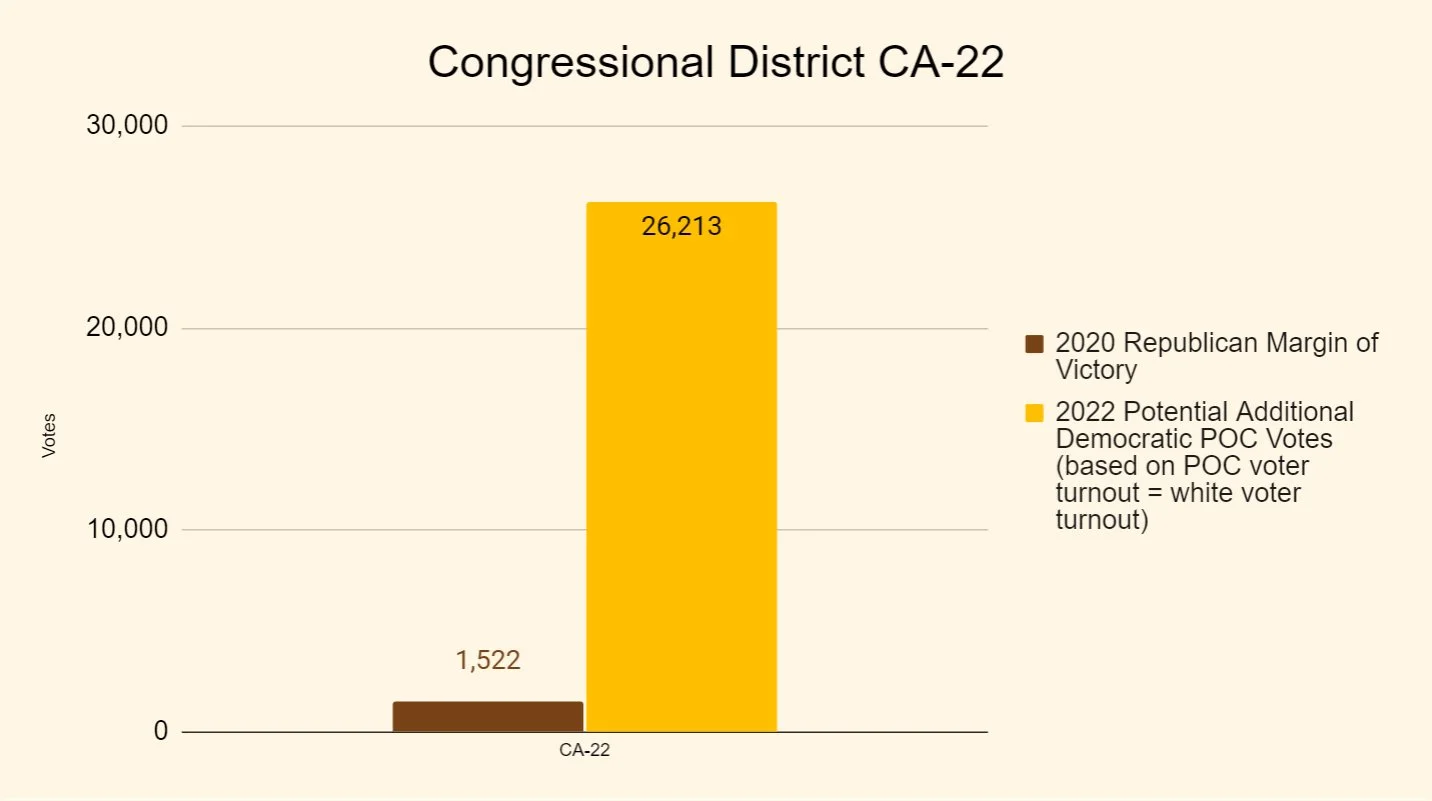
In 2022, there would be over 149K votes cast for Democrats by voters of color if eligible people of color turned out at the same rates as their white counterparts did in 2020, which is over 26K more than in 2020 .
The GOP margin of victory in that House race was only 1,522 votes in 2020. The 2018 race was also extremely close with only 862 votes more for the Democrat, TJ Cox.
Democrats Positioned to Hold Senate
One simple fact should frame all election analyses: the Democratic presidential nominee has won the popular vote in every single election since 1992 (with the sole exception of John Kerry’s narrow 2004 loss).
By Steve Phillips

Photo by Colin Lloyd on Unsplash
One simple fact should frame all election analyses: the Democratic presidential nominee has won the popular vote in every single election since 1992 (with the sole exception of John Kerry’s narrow 2004 loss).
Most recently Joe Biden won by seven million votes. What this data shows is that there is a progressive New American Majority consisting of an electoral coalition between people of color (who make up roughly 75% of this majority) and a meaningful minority of whites (roughly 40%). This majority is growing every single day as 11,000 people—half of them people of color— turn 18 and become eligible to vote. (The threat posed by these demographic trends is clearly understood by Republicans. That’s why they devote so much time, energy, and attention to trying to prevent members of the New American Majority from voting.)
The current conventional wisdom that Democrats are facing an uphill battle in the November midterm elections is grounded in an incorrect interpretation of the tendency for the party that controls the White House to fare poorly in midterms. But that trend is largely a function of apathy and complacency among the voters whose party won the White House, which drives down that party’s voter turnout. It’s not because voters are punishing the party in power by voting for the other party.
Democratic losses in the midterms are far from foreordained, and if they work on boosting turnout, they actually stand a good chance of increasing their margin in the U.S. Senate. Currently there are 48 Democrats, 2 Independents who caucus with the Dems, and 50 Republicans serving in the Senate. VP Kamala Harris holds the tie-breaking vote and Democrats control the Senate under a power sharing agreement. There are 34 Senate races this November.
Heading into the homestretch of the election, Democrats have opportunities to pick up as many as five seats and hold four that were previously considered vulnerable.
Temperature gauge
The macro political environment is actually improving Democratic prospects by firing up their voters and clarifying the stakes. The backlash to the Supreme Court’s Handmaid’s Tale-like decision to overturn Roe v. Wade is real and powerful, leading Tom Bonior, head of the data firm TargetSmart, to write a column titled, “Women Are So Fired Up to Vote, I’ve Never Seen Anything Like It.”
In a very pleasant political surprise, the Biden White House seems to have “found religion” about the electoral importance of inspiring and mobilizing the New American Majority. A Washington Post article on the backstory behind the decision to pursue student loan debt relief found that Biden, “became convinced that aggressive student debt relief would give Democrats a better chance of holding Congress in the fall through a badly needed boost from young voters and people of color.” And the Inflation Reduction Act marked the historic passage of climate change legislation, a key priority for young people in particular.
Pick Up Possibilities
Florida: Val Demings (D) v. Marco Rubio (R)
“Sheriff Demings” is outraising incumbent Marco Rubio, but he still has more cash on hand. Demings will have more than enough money to compete in November.
More than one-third of registered voters in Florida are people of color. With targeted outreach to these voters, Demings could increase the relatively lackluster average turnout rates of the POC population relative to whites (just under 60% of people of color turned out in the 2020 election compared to 67% among whites) and pull off a victory in November.
There are 3,112,000 POC voters in Florida who did not vote in 2018, and the Demings team is registering and doing extensive voter outreach with these eligible voters.
North Carolina: Cheri Beasley (D) v. Ted Budd (R)
This open seat creates a better opportunity for Democrats especially ever since the GOP nominated their weaker candidate.
Beasley is currently outraising Budd; she bought $10.3 million in TV ads vs. $2.1 million by Budd.
North Carolina has a large unaffiliated group of registered voters who likely will be turned off by Budd's close ties to Trump and the Club for Growth, a Republican-aligned super PAC that is supporting Budd.
One-third of registered voters in North Carolina are people of color, but they vote at lower rates than whites, especially Latinos who trail whites by over 17 points.
There are 1,189,000 POC voters in NC who did not vote in 2018, and Team Beasley is registering and doing extensive voter outreach with these eligible voters.
Pennsylvania: John Fetterman (D) v. Mehmet Oz (R)
Fetterman currently leads by double digits in multiple polls, although recent Emerson College polling shows his lead shrinking.
Republican nominee Dr. Oz is flailing after showing how out of touch he is with normal people with his “crudité” video attempting to pass himself off as a commoner.
Almost 1 million POC are eligible to vote in PA but didn’t cast ballots in 2018. Democrats are targeting outreach to African American, Latino, and AAPI communities in PA to ensure that they register and vote in 2022.
Ohio: Tim Ryan (D) v. J.D. Vance (R)
Although Democrats not named Sherrod Brown have fared poorly in Ohio in recent years, Tim Ryan has made this race surprisingly competitive as he runs against Hillbilly Elegy author—and now hedge fund honcho—J.D. Vance who is trying to run on a narrative rather than a record.
This race is a virtual tie according to FiveThirtyEight despite structural advantages for the GOP.
Ryan successfully cast himself as the champion of working families and Vance has failed to seize on opportunities to rally the Trump base.
Ryan is currently outspending Vance in ad buys, but the GOP has thrown $28 million into the race.
Over 809,000 POC are eligible to vote in Ohio but didn’t cast ballots in 2018, and the Ryan campaign will need to improve turnout among these communities to win in November.
Wisconsin: Mandela Barnes (D) v. Ron Johnson (R)
A recent Fox News poll shows Barnes with a 4-point lead (50% Barnes to 46% Johnson). Marquette Law School poll shows Barnes with a 7-point lead.
Johnson continues to assert falsehoods and has low approval ratings, but he managed to win once before despite his outlandish comments, so it’s too soon to say if Barnes has locked it up yet.
Wisconsin is home to well over half a million POC eligible voters, yet in 2018 fewer than half (262,000) made their voices heard at the ballot box. Team Barnes will need to target the 275,000 POC eligible voters who sat out in 2018 to increase their 2022 turnout rate.
Holding Strong:
Arizona: Mark Kelly (D) v. Blake Masters (R)
Masters won the nomination with racist and misogynist rhetoric, but is now trying to recast himself as a family man concerned about women.
Masters’ extremist history will make it hard for his backtracking to stick. Recent polling shows Kelly at or above 50%, and FiveThirtyEight gives the incumbent, Kelly, an average lead of 8.3 points.
With over 35% of registered voters in Arizona being Latino, targeted voter engagement among this group will enable Kelly to prevail. In particular, increased turnout among Latinos this cycle can prove pivotal, given only 61% of registered Latinos voted in 2020 compared to 77% of white voters.
Georgia: Raphael Warnock (D) v. Herschel Walker (R)
Cook Political Report says: "Walker has baggage that could take up a football field."
With one-third of registered voters in Georgia being African American, Warnock's turnout effort will prove critical.
In 2020, Black voters lagged behind whites in turnout rates by over 6 percentage points. If Warnock can tap into potential Black voters, he can easily win a full Senate term.
Warnock will also benefit from Stacey Abrams’ massive Get Out the Vote operation that helped propel him into office in the first place in January 2021.
New Hampshire: TBD (Primary Sept. 12th) v. Maggie Hassan (R)
This is one of the few true “swing states” in the country, where voters, mainly white, regularly shift their allegiances between the parties, and most races are narrowly decided.
Hassan has lackluster numbers with only 39% of voters saying she deserves to be reelected.
But the GOP seems unlikely to find a nominee who will be able to oust her. Trump and Senate dysfunction kept their strongest candidate, Sununu, out of the race.
Nevada: Catherine Cortez Masto (D) v. Adam Laxalt (R)
Former Nevada attorney general, Adam Laxalt, is not as extremist as other Republicans, although he co-chaired Trump’s 2020 reelection campaign in the state.
Incumbent Catherine Cortez Masto, the first Latina to serve in the U.S. Senate has distanced herself from Biden and opposed student loan forgiveness.
Polling average gives her a 3.7 point lead over Laxalt.
One in five registered voters in NV are Latinos. Dems have been working for months to counter trends in registration that show Latinos moving away from the party. If Dems can increase the usual dismal turnout among Latinos in the state (46% compared to 70% among white registered voters), Cortez Mastos could easily hold this seat.

5 Civic Engagement Groups Fighting to Protect Democracy
It’s hardly news by now that President Joe Biden and other Democrats would not have performed as well as they did in the 2020 presidential election or the 2021 Georgia U.S. Senate runoffs if it weren’t for the millions of voters of color and young voters who turned out to the polls in record numbers. Less talked about, however, are the organizations that worked tirelessly to make all of that possible.
These groups are leading the charge on how we win in 2022 and beyond
By Fola Onifade

Photo by Tom Barrett on Unsplash
It’s hardly news by now that President Joe Biden and other Democrats would not have performed as well as they did in the 2020 presidential election or the 2021 Georgia U.S. Senate runoffs if it weren’t for the millions of voters of color and young voters who turned out to the polls in record numbers. Less talked about, however, are the organizations that worked tirelessly to make all of that possible.
Organizers and voting rights groups across the country worked for months, days and hours, knocking on doors, calling prospective voters, and making sure that everyone who had the ability to vote could make their voices heard. Because of these groups, many who still remain under the radar, Democrats were able to flip Georgia and Arizona and win the White House and majority in Congress.
If Democrats want to keep and ideally expand their majorities in Congress this year and hold on to the presidency in 2024, they can’t afford to sleep on these organizations. That means providing these groups with substantial, long-term financial support, and listening to and valuing the expertise of these organizers.
Below are five civic engagement groups you should know and why.
1. New Georgia Project
If you haven’t heard of the New Georgia Project (NGP), that’s about to change right now! Founded by Stacey Abrams in 2014, Democrats would not have been able to win a Senate majority without the efforts of this group. As of 2019, NGP has helped register over half a million voters across Georgia’s 159 counties, contributing to the massive voter turnout in 2020 and 2021.
This midterm, New Georgia Project is working to get Senator Raphael Warnock reelected. They are also helping Rep. Bee Nguyen become the first Asian American Secretary of State, a seat that is increasingly important given the role the SOS plays in certifying state election results.
To learn more about the work in Georgia that helped flipped the state, listen to our podcast episode with New Georgia Project Action Fund’s Nse Ufot and check out Stacey Abrams and Lauren Groh-Wargo’s piece in The New York Times detailing exactly how they flipped this red state blue.
2. Florida Rising
Florida remains an important battleground state. While mainstream media sources love to focus on Latino voters who vote Republican (ultimately a small fraction of Latinos as a whole), the reality is that Florida’s Latino population is extremely diverse. Millions of folks within this population support progressive candidates and policies.
Florida Rising is a civic engagement group that has built a presence in 13 counties in the state as well as a larger network of like-minded groups in all 54 counties. This midterm, Florida Rising is working to help Democrats expand their majorities in Congress, including Rep. Val Demings who is running to replace Republican Senator Marco Rubio as the first African American Senator from the state.
Read this Scalawag article by Anoa Changa to find out more about the organization’s work in the state. Then check out this chapter in Power Concedes Nothing penned by Florida Rising’s Executive Director Andrea Mercado titled “Florida’s Rising Majority Learns from Its Wins — and Its Opponents.”
3. Texas Organizing Project
Compared to other states, Texas has the greatest demographic potential to upend the balance of power in the U.S. In 2020, Biden came within 631k votes of winning Texas, a state that has over 4 million unregistered voters of color. Imagine if just half of them voted every election cycle!
The Texas Organizing Project (TOP) is a voting rights group dedicated to harnessing the power of people of color in Texas. Founded in 2009, the group has over 285,000 members and has reached over 6 million voters, many of whom are Black and Latino. With the right level of support to fight back against some of the worst voter suppression in the country, Texas can become an increasingly viable battleground state for Democrats and progressives.
Check out this Scalawag article by Anoa Changa to learn more about the group from TOP’s co-Executive Director Brianna Brown.
4. LUCHA (Living United for Change)
In 2020, the Democratic victory in Arizona thwarted Trump’s plan to prematurely claim he had won the presidential election. That victory was a decade in the making, a result of politically engaged Arizonans who organized and fought back against the heinous SB1070 or “show me your papers” bill that enabled police officers to behave as immigration agents back in 2010.
LUCHA, which was founded in 2010, was one of those groups. Since its founding, hundreds of thousands of voters have been brought into the political process. This year, Arizona remains a key state with an important gubernatorial race and Senate race, and LUCHA’s role in driving voters to the poll will be critical.
Read this 2019 New York Times piece from the group’s Co-Executive Directors Alejandra Gomez and Tomás Robles on how to turn anger and fear into political power. And check out our episode with strategist John Loredo to learn more about the work happening in Arizona.
5. Communities for New California
Most people see California as a safe blue state. While that’s true, there’s still plenty of pockets where Republicans remain competitive, including several districts across the Golden State that offer Democrats multiple opportunities to expand their majority in the House.
Communities for a New California is a civic engagement group founded in 2011 that’s been organizing voters of color in these competitive districts to help grow progressive power in Congress. Under the leadership of Founding Executive Director Pablo Rodriguez, the group has reached over 13 counties and engaged over 250K voters.
This midterm election, there will be several contestable Republican seats in California. With the right support, CNC’s work can help boost turnout and increase Democrat’s chances of winning more House seats.
To learn more about these groups and similar organizations doing the work to advance democracy and justice, check out our newly launched Election Playbook.
4 LGBTQ+ Women of Color Fighting for Equality
To close out Pride Month, we’re re-upping four episodes featuring inspiring LGBTQ+ women of color across the country who are showing up unapologetically and fighting for equality.
These women remind us to honor Pride year-round
Edited by Fola Onifade
To close out Pride Month, we’re re-upping four episodes featuring inspiring LGBTQ+ women of color across the country who are showing up unapologetically and fighting for equality.
If you like what you hear, you can find all of our podcast episodes here.
Know someone who should learn more about these incredible women? Share this page with them because that’s how we build power!
Not a Nation of Immigrants w/ Anathea Chino

Anathea Chino (left), Founder of Advance Native Political Leadership and historian and activist Roxanne Dunbar Ortiz
Anathea Chino is the co-founder and executive director of Advance Native Political Leadership, the first and only national native organization focused on electing Native Americans to local and state leadership.
Listen to the full episode with Anathea below or wherever you get your podcasts.
Pride: Hope, Struggle and Taking Back Power

Rebecca Marques is the Texas state director for Project One America in the Human Rights Campaign, where she leads the organization's legislative and electoral work.
Listen to the full episode with Rebecca below or wherever you get your podcasts.
Texas: Queer Cowgirls, Colonias, and Climate Change

Dr. Mary Gonzalez is a state legislator in the Texas House of Representatives representing El Paso, Texas.
Listen to the full episode with Mary below or wherever you get your podcasts.
Black History, Black Futures: A Conversation with Jessica Byrd

Jessica Byrd is the founder of Three Point Strategies, a home for electoral strategy that centers racial justice. She is one of the architects of the Movement for Black Lives Electoral Justice Project and the Black Campaign School. Jessica has served as chief strategist for black women, U.S. Senate candidates, congresswomen, mayors of major metropolitan cities, and she served as the chief of staff to gubernatorial candidate Stacey Abrams in 2018.
Listen to the full episode where we discuss Vanita below or wherever you get your podcasts.